on professionalism > 05/06/06
response (0) filed under:
response (0) filed under:
A quilt of testimonies about the impact of technology on writing is being built at trAce as it celebrates its tenth anniversary.
response (0) tagged: filed under: metatexts :: on writing
Looking at the UNESCO/WSIS Declaration of Principles for the internet, it becomes clear that the declaration rejects the bifurcation of, on the one, the information society as part of globalization on corporate terms and the subsequent increase in the digital divide and, on the other, knowledge societies that rely on affordable, free and open-source software and diversity in formats that enable global accessability regardless of the underlying technology.
response (0) tagged: filed under: the Other :: cultural diversity and otherness
In many ways, my vision and practice of hypertext link up with Roland Barthes’ theory of the text. This is not a ‘hard’ theory but rather a speculation held together by a continuous engagement with language, literature, photography and the pleasures of reading. Part of that theory, his differentiation between work and text has become a mantra for many hypertext critics in that Barthes here differentiats between work, which is a closed linear narrative, and texts that are open-ended and decentered.
response (0) tagged: digital writing filed under: on writing
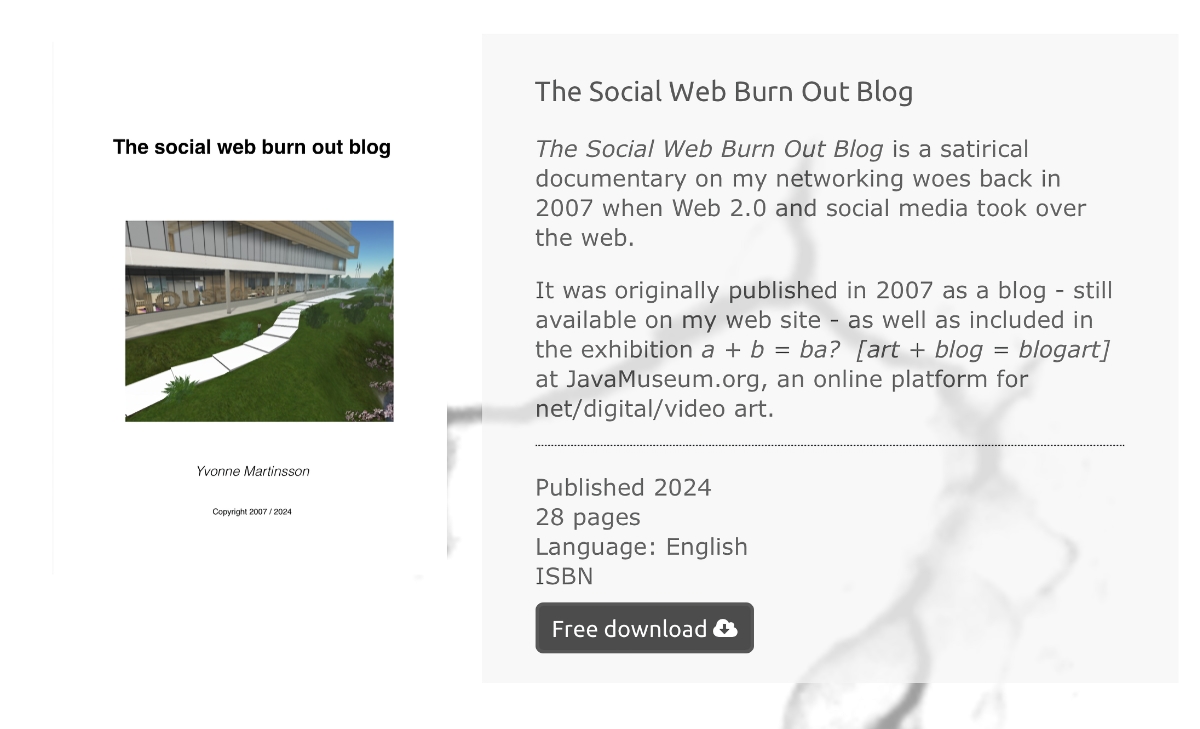
My 2007 documentary blog on my woes on the social web is now available for download in pdf. Check it out!
freewheelin.nu is a site where e-lit, installations, digital art, blogs and other texts are linked in a hyperdimensional space of underpasses, highways, rivers, bridges, tunnels that intersect in the art project Plastic Spaces whenever possible.
And there is more. Image music text and technology intertwined in digital art and textual [dis]pleasures - in the erratic vibrancy, evanescence and intangibility of the text/work - that interfaces with the erotic body [electrified].
